

The episode is features Gil McGowan, president of the Alberta Federation of Labour (AFL), about Alberta’s first province‑wide Day of Action scheduled for Friday, May 29, framed as a broad, democratic protest against the current provincial government’s direction and a starting point for a longer‑term movement.
Gil describes the AFL as Alberta’s oldest and largest worker advocacy group, an association of 27 unions representing about 175,000 workers in public and private sectors, founded 114 years ago in Lethbridge by coal miners and tradespeople to fight for the eight‑hour day, health and safety, and minimum wage. He shares his background as a rural Alberta farm kid turned journalist who became active in his union and eventually AFL president.
Gil explains that unions in the AFL decided in December to create a province‑wide day of protest on May 29 because they and many Albertans felt “things were going off the rails” under Premier Danielle Smith’s government. The immediate trigger was Bill 2, which forced striking teachers back to work and stripped their constitutional right to strike, but they quickly saw broader concerns: workers’ rights, two‑tier healthcare, attacks on education, cuts to supports for disabled people, and targeting of Indigenous communities and vulnerable LGBTQ+ kids. He characterizes the government’s approach as “MAGA North” tactics of divide, distract, and scapegoating, and says many Albertans are “quietly horrified” by this direction. Traditional democratic tools like petitions and letters are being ignored, he argues, while the government uses a “flood the zone” strategy—constant policy attacks and chaos—so he believes a unifying protest movement is needed to bring together people with many different concerns.
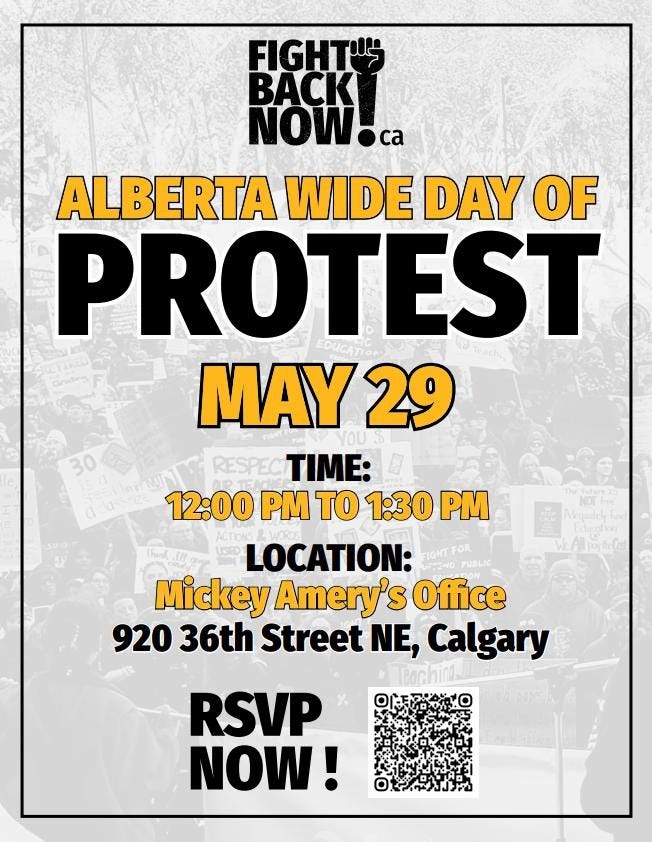
Warm up your protest voice by singing to the “Injustice” Minister, Mickey Amery, at his office (920 36 Street NE) from 12:00 to 1:30 pm. Here is the chorus, feel free to bring a verse or two!
May 29 is deliberately on a Friday to move from symbolic weekend demonstrations at an empty legislature to at least some level of disruption while MLAs are actually at work. Instead of a single rally in Edmonton, they chose a decentralized, grassroots model: protests “everywhere,” with local committees in 14 communities, including Edmonton, Calgary, Fort McMurray, Grande Prairie, Red Deer, Lethbridge, Medicine Hat, and smaller towns. They launched the Fight Back Now campaign and website (fightbacknow.ca) as the organizing hub for May 29 and potential future protest days, inviting both labour and non‑labour civil society to lead and participate. Gil notes that in Calgary, for example, there will be a large rally at Riley Park at 5:30 p.m. and a smaller protest at Justice Minister Mickey Amery’s constituency office at noon, targeting the “injustice minister” for enabling a separatist agenda.
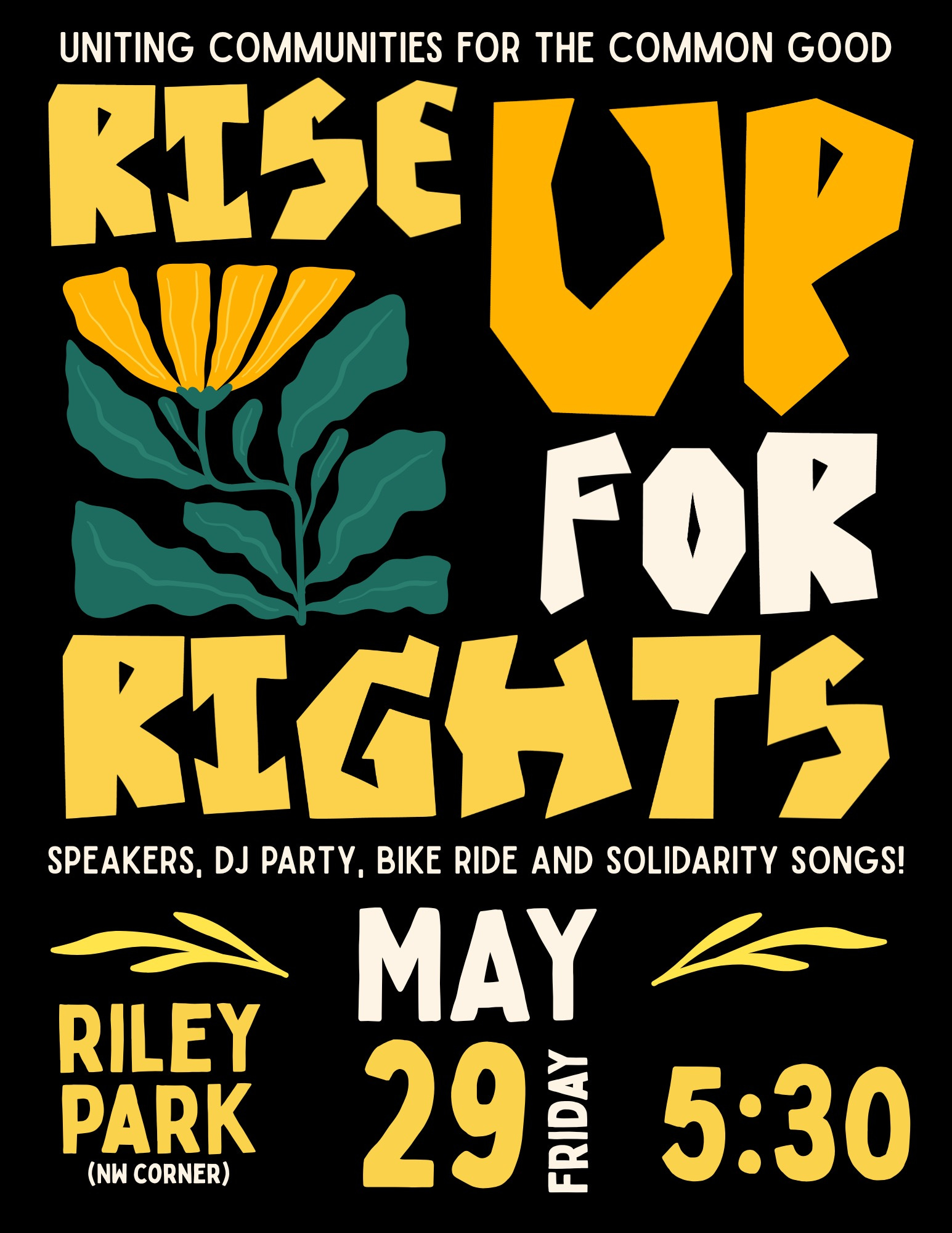
Then ride your bike down to Riley Park!
Event schedule:
Gather in the NW corner of Riley Park (8 Ave and 12 Street NW)
Celebrate with dance music
Optional: Bring your bike and join the Critical Mass ride at 6:30 pm
Meet many groups working on diverse causes
Hear from expert speakers
Take part in the solidarity song writing contest! Perhaps we’ll have a full Mickey song to share.
Gil and I argue that the UCP’s current agenda lacks a democratic mandate: the 2023 election was close—decided by roughly 3,000–6,000 votes in a handful of Calgary ridings—and the party did not campaign on two‑tier healthcare, exiting the Canada Pension Plan, or separatism. We highlight that the government’s first major bill was the Sovereignty Act, which was not part of the campaign platform. Gil calls the government “founded on dishonesty” and says many UCP voters now feel betrayed because “this is not what I voted for,” and the May 29 protests are also a platform for those disillusioned supporters.
We delve into the ideological roots of the current agenda, focusing on the “Free Alberta Strategy,” co‑authored by Rob Anderson, Danielle Smith’s campaign manager and current chief of staff, which Gil likens to a Canadian version of the U.S. Project 2025. He says the document lays out a blueprint and timeline for moving Alberta toward MAGA‑style politics and separatism, and that Smith has been following it “component by component,” starting with the Sovereignty Act. Polls show separatism is supported by only 25–35% of Albertans overall, but it is a majority view within the UCP and is especially popular among higher‑income earners (over $150,000) who feel economically insecure. Gil and I connect this to oil and gas interests, noting that many leading separatist and UCP figures come from the sector, and that wealthy investors with heavy stakes in fossil fuels oppose anything that might limit expansion, such as climate policy or energy transition.
Gil frames this as part of a global “incumbent’s dilemma”: oil and gas, historically the most powerful industry in the world, now faces serious competition from increasingly cheap renewable electricity. Instead of pivoting and investing to remain competitive, he argues, many incumbents are “stacking the deck” through politics—lobbying, capturing governments, and seeking subsidies—while criticizing renewables for subsidies even as major oil projects now rely on public support. He sees the rise of separatism and MAGA‑style politics in Alberta as a desperate attempt by fossil fuel incumbents to protect their status by rigging the system rather than preparing for a different future, and warns that this is against the long‑term public interest, including that of oil and gas workers.
I stress the need for responsibility beyond Alberta’s borders, especially regarding water that flows to Saskatchewan and Manitoba, arguing that separatist rhetoric shrinks responsibility to “imaginary borders” and ignores interprovincial obligations. The oil and gas industry, with the largest footprint on the landscape, must lead in land and water restoration. I want to return to the industry to focus on stewardship. I also note that subsidies like the Site Rehabilitation Program are preferable to subsidizing new pipelines with questionable markets, and uses this to illustrate how public funds could support reclamation rather than expansion.
The organizing model for May 29 draws inspiration from the U.S. “No Kings” movement, which mobilizes mass protests in defense of democracy against Trump‑era authoritarianism. Gil says they deliberately adopted a similar grassroots, self‑organizing structure: the Fight Back Now website serves as a hub where local committees form, meet online, and then organize real‑world actions, with many committees now meeting independently. The goals mirror No Kings: show people you are not alone, counter the exhaustion caused by “flood the zone” tactics, and create a single space where multiple issues—healthcare, education, worker rights, separatism, minority rights—can converge into a unified movement against authoritarianism.
Gil situates this within a broader historical context, citing movements like Poland’s Solidarity and Ukraine’s Orange Revolution as examples of successful citizen coalitions that united diverse groups against authoritarian regimes. He emphasizes that May 29 is intended as the beginning, not a one‑off event: the AFL recently helped convene an Alberta Civil Society Summit with about 200 participants from unions, Indigenous groups, student organizations, seniors, and racialized and immigrant communities, and they plan more protests and another summit in the fall to deepen cross‑sector networks.
I underscores the importance of “organizing for power” and praises the labour movement’s experience in structured organizing: having hard conversations, clarifying expectations, and building long‑term solidarity rather than one‑time actions. I note that AFL’s role is to seed and support, not control, the movement; in Calgary, for instance, the May 29 committee has more non‑union than union members and is chaired by community activists, which Gil welcomes as evidence of genuine grassroots growth. Gil recounts that the premier’s office mocked him and predicted failure when Fight Back Now was announced, pointing to past efforts like general strike threats and recall campaigns, but he argues that thousands of Albertans were mobilized through those recalls despite artificially high thresholds, and that these experiences built a base of activists now moving into “phase two.”
Gil and I frame the UCP’s rule‑changing as a hallmark of creeping authoritarianism: lowering thresholds for separatist initiatives while imposing high hurdles on citizen‑driven recall and initiative campaigns, and changing laws to shield the government from court decisions. We argue that Alberta’s political stereotype—conservative, pickup‑driving, oil‑patch “Joe Alberta”—obscures a much more diverse population, and that the UCP’s MAGA‑style project is “awakening a sleeping giant” of citizens who want to remain in Canada, protect public services, and reject authoritarianism. Gil insists that these citizens are likely the majority and that their real power lies in collective action, which the May 29 protests aim to facilitate.
In the final part of the conversation, I ask Gil to address accusations that the AFL is simply an arm of the NDP and to explain why a widely expected general strike did not occur after Bill 2. Gil responds that while many union activists vote NDP, the AFL and NDP are functionally separate: only 2 of 27 affiliated unions are formally connected to the NDP, and most unions are officially or functionally non‑partisan, with members repeatedly telling the AFL not to dictate their votes. He argues that workers naturally gravitate away from a government that refuses to raise the minimum wage, attacks public services, and strips the right to strike, and that his job is to defend workers’ interests, which currently means opposing the UCP. He also notes tensions with the NDP: the AFL has developed its own “Worker Agenda,” a detailed policy blueprint on affordability, wages, public services, jobs, and the economy, including proposals like a $20 minimum wage, public auto insurance to lower Canada’s highest auto premiums, and re‑regulating Alberta’s fully deregulated power system, which he says was effectively designed by former Enron figures. He wants the NDP to adopt more “progressive populist” policies—“more like Bernie than Hillary”—but stresses that the AFL’s platform is independent.
On Bill 2 and the missed general strike, Gil gives a candid account: anticipating use of the notwithstanding clause against striking workers, the AFL created a “Common Front” of AFL and non‑AFL unions and a “Solidarity Pact” pledging mutual defence if any group’s right to strike was attacked. When the government used the clause against teachers in October, ordering them back to work with threats of $500‑per‑day fines for individuals and massive fines for the union, the teachers’ leadership decided not to defy the order, partly because they had already been on strike for three weeks and lacked a strike fund. At a critical October 29 meeting, some major union leaders argued they could not ask their members to undertake illegal strikes and face similar fines if the teachers themselves were not defying the order, and “the air went out of the balloon.” Gil and AFL vice‑president Corey Longo did move a motion for a one‑day general strike and many unions were ready, but without teacher defiance the plan collapsed. Gil says he will not blame teachers, but believes the labour movement “missed an opportunity,” let Albertans down, and emboldened the government to escalate; organizing the May 29 Day of Action and future protests is, in his view, part of atoning for that failure.
The episode closes with my reiterating that separatism, though a symptom rather than the root cause, is serious and well‑funded, and that the May 29 protests are a chance for people to stand together on whatever issue matters most to them—separatism, healthcare, education, worker rights, or democratic norms.


