

CBC Reporter, Eagle Andersen called me to hear my thoughts about the updated information provided by Kevin’s “O’Leary Digital” team in advance of their open house slated from tomorrow, June 4 from 4-7 pm at Grovedale Community Hall in Grande Prairie.
I criticize the new newsletter about a proposed data centre project for omitting key information about what powers the facility, assuming it will rely on natural gas and arguing that this leaves out major parts of the electricity, water, and contamination story. I highlight that the project is expected to use about six billion liters of water per year (six million cubic meters), which is roughly equivalent to the annual allocation for the Greenview District, effectively doubling municipal water use for a single project and with no guarantee that usage would remain capped at that level. I also note concerns about power demand, citing examples like Lake Tahoe where residents were reportedly told they could no longer get grid power due to a data facility, and emphasize that a seven‑gigawatt facility would be a massive addition, equating five gigawatts to the power needs of five million people.
I argue there is “zero benefit” to Canada and Albertans, claiming the project offers only limited construction and operations jobs and primarily serves U.S. government interests, which they accuse of trying to push Canada toward violating international law, climate obligations, and stability. I add that, especially after the war in Iran and anticipated resource shortages, leaders should make “extreme choices” to limit use of fossil fuels and ensure benefits do not accrue mainly to fossil fuel interests.
When asked what information the company should provide, I say the full scope of the project must be disclosed, including how power will be generated and the associated infrastructure, pointing to the example of Olds where oil and gas workers understand the gas turbines, roadways, and infrastructure needed for such projects. Drawing on personal experience working near Grande Prairie, I speculate that a large gas cap over an oil field might be used to extend the life of a field instead of addressing environmental cleanup obligations, calling this a likely costly error. I also reference the prime minister’s recent statement that the U.S. is misleading and argue Canada should not follow a “mega pipeline drill, baby drill” agenda.
On public engagement, I describe significant opposition in Olds, describing “major outcry” and strong grassroots organizing, including people handing out posters and flyers and encouraging Albertans to file statements of concern against the project. I mention an upcoming open house in Olds on June 24, to be attended by the premier and local MLA Sawyer, and question whether Grande Prairie has been given a similar opportunity. For the upcoming open house in the Grande Prairie region, they say they hope the project is “shut down immediately,” arguing Greenview County should prioritize supporting farmers and the agricultural economy and focus on water restoration and cleanup operations instead. I suggest stopping the project now to limit any damages O’Leary’s business could claim, referencing the Grassy Mountain coal project as a precedent where the answer was to “settle.”
I explain my participation a recent webinar through Public Interest Alberta was to inform the public about environmental liabilities and the impacts of data centres on water use, cybersecurity, and water security, describing these facilities as “non‑starters” and noting similar projects have been stopped elsewhere. I see data centres as another face of fossil fuel expansion and argue that carbon capture and storage is not a genuine climate solution, based on their industry experience. I insist fossil fuel expansion for hydrogen, LNG export, or data facilities—especially those they say could benefit “nefarious actors”—must not proceed, and that public opposition and on‑the‑ground action are the only ways to stop such projects.
Regarding the webinar’s reception, I report that hundreds attended and feedback was “really good, really strong,” and they mention a planned follow‑up interview on their platform “The Gravity Well” and further efforts by environmental organizations to keep sharing information. I warn that data centres should not be appealing to Albertans because they bring in large corporate and billionaire interests that do not help the province through challenging times.
When asked why I care, I explain how this is about “our present and our future,” citing their two children and Alberta’s role as a headwater province that should focus on restoring water rather than extracting more fossil fuels. They reference the “keep it in the ground” philosophy and carbon pricing as concepts originating in the oil and gas industry, arguing that remaining resources are not worth extracting and would cause irreparable harm, which motivates them to do this work even without pay.
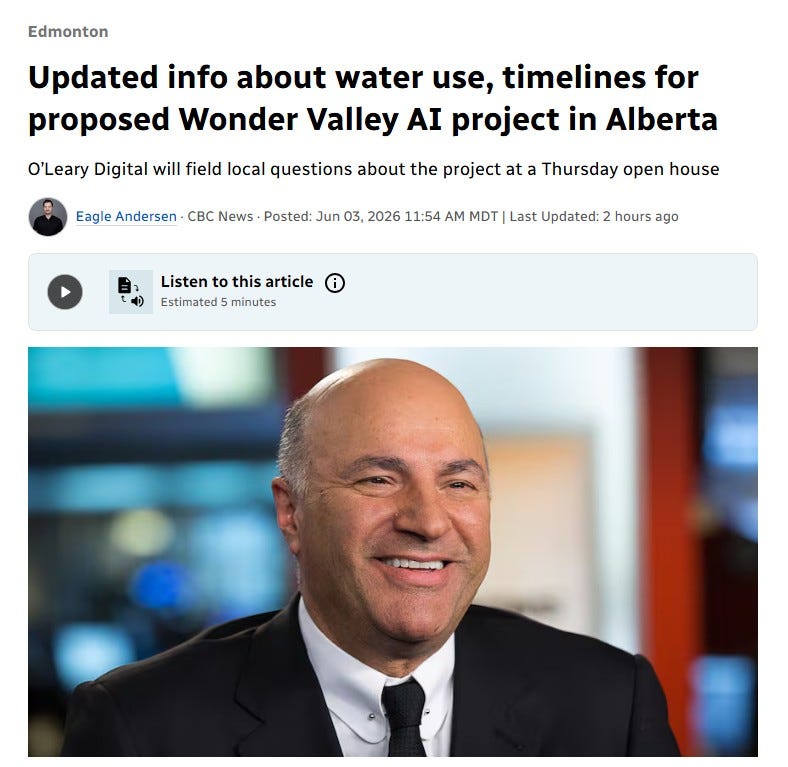
Here’s the link to Eagle Andersen’s article, please follow him as he will be attending the open house tomorrow and hopes to gain a statement from the Sturgeon Lake Chief. Jody MacPherson of The Missive is following the Wonder Valley story closely: https://www.theenergymix.com/hidden-wonder-valley/.


